Persepolis: The Story of a Childhood by Marjane Satrapi
This is a graphic novel-style non-fiction memoir by a woman who grew up during the Islamic Revolution in Iran. Her parents were Communists and many of their friends were targeted and imprisoned or killed. She grew up with a fervor for knowledge and a gutsy stick-it-to-the-man attitude, encouraged by her parents, which got her into trouble when she questioned the rewritten history she was taught in school after the change in government. To be honest, I have little knowledge of Iranian political history, so in some parts of the book I just had to take her word for it, which was sometimes hard because it was written in the style of the age the author was at the time. I think it was interesting to have the combined perspectives of 1. a woman in 2. a liberal family in 3. a Middle Eastern country with its share of political and religious conflict. B+
“Jonathan Strange and Mr. Norrell” by Susanna Clarke
This book really held my attention well considering that not much action actually happened for most of the book. It is the tale of two English magicians, the only two “practical magicians” in England, at the time of King George III. To keep the story moving along, the author finds ways of weaving new characters into a deep-held secret that only Mr. Norrell and the reader really understand for most of the story. Even though it’s an 800+ page book, I never really found myself bored because I got invested in the separate storylines that were sometimes close together and sometimes almost unrelated, and sometimes tied to actual events in history. Characters from previous parts of the story kept popping back up and knitting the storylines back together. I wasn’t all that satisfied with the way that the story ended because I felt like it should have been more finished, but the rest of it was so involved I felt like I was actually in the time period. A-
“Artemis Fowl” by Eoin Colfer
The premise of the book really put me off. Artemis Fowl is a young genius and heir to the fortune of a crime family which has lost its partriarch. He’s twelve and is just too brilliant and too cocky for my liking. I just don’t like books in which children are given more autonomy than they are supposed to have. He cooks up a plan that involves kidnapping a fairy soldier (I’ll admit that the rewriting of folklore into a “what humans think they know but don’t” mythology was pretty clever) and holding her for ransom, negotiating with the supernatural military for her release, pretending to want something that he doesn’t… oh it was all too contrived for a twelve year old. Maybe it would be more fun for someone who actually is twelve or younger, but I’m not buying it. C-
“The Ride Together: a Brother and Sister’s Memoir of Autism in the Family” by Judy Karasik and Paul Karasik
This book was co-written by the brother and sister of a man with autism. The sister writes in normal chapters, and the brother delivers his experience in graphic novel style, which worked especially well in some parts because of his brother’s interest in Superman. I especially liked it because the brother with autism was older than both of them, so they don’t tell much about his childhood, but mostly the family’s experiences bouncing him around to different group homes as an adult and his visits home during vacations or transitions. One transition near the end of the book was hard to read about because it came about when the facility was shut down because of abuse of residents by the caretakers. It spoke to me as a person who works with people with disabilities to say never, ever take advantage of a situation in which you are the person in power. A-
“Mrs. Frisby and the Rats of NIMH” by Robert C. O’Brien
I think the last time I read this book I was in the fourth grade. It’s a little bit magical to read something that you thought you knew as a kid. I didn’t remember all the action in the story happening within just a few days, but that was probably because my class read the story over several weeks with vocabulary and comprehension sheets in between. The way the rats build up their civilization is so imaginative and complete, I can really see why this book was a Newberry Award Winner. A-
Monday, March 15, 2010

Monday, February 8, 2010
Project 50 Redux: January
I’m still working through “Jonathan Strange and Mr Norrell, which is an 800+ page monster, so I haven’t had time for much else.
"Coraline" by Neil Gaiman
I saw the movie before I read the book, and honestly…I liked the movie better. I felt like the book moved too fast without all the other extra things that the movie put in. As a book alone, it’s ok, but I didn’t get all that attached to Coraline even. C+
"Coraline" by Neil Gaiman
I saw the movie before I read the book, and honestly…I liked the movie better. I felt like the book moved too fast without all the other extra things that the movie put in. As a book alone, it’s ok, but I didn’t get all that attached to Coraline even. C+
Saturday, January 2, 2010
Project 50: December
The year ended with a total of 56 books read. I could increase my goal to 60, but honestly, I think trying to read more than a book a week would make reading less enjoyable, and that's why I read, so I'm sticking with 50 books a year.
“Adopting on Your Own: The Complete Guide to Adoption for Single Parents” by Lee Varon
I thought that this book was really balanced and thorough. It’s written by a woman who adopted internationally, a toddler from Guatemala in her 30s and a 4 year old from Russia 14 years later. She really encourages singles considering adoption to examine themselves and their reasons for adopting, their abilities to support a child, what age and sex of child they want to adopt and why, whether they want to adopt internationally, domestically, through a private agency, through a state agency. She freely admits that adoption is not for everyone, not even for some couples, and prints testimonies from singles who had success in their adoption, trials, or who finally decided not to go through with it. It gave me a lot to think about. A
“The Skull of Truth” by Bruce Coville
Bruce Coville was one of my favorite authors as a kid. This book is in a serious of Magic Shop Books that includes “Jeremy Thatcher, Dragon Hatcher” and “Jennifer Murdley’s Toad.” Charlie “accidentally” steals a skull from a mysterious magic shop which talks to him in his head and causes Charlie, a compulsive liar, to always tell the truth. Hijinx ensue. There are a couple of parts that are fairly typical for Coville, in which children have a lot more influence over adults than they would have in real life. It works for children’s literature, but might not appeal to all adults. I think that the origin story that Coville invents for the skull is particularly clever (hint: the skull’s name is Yorick), and could encourage kids to branch out into more advanced literature. B+
“Watching the English” by Kate Fox
This book is a sociological study of English behavior, written by a native Englishwoman who spent part of her childhood in France and America. I don’t know that it’s fair for a native to examine her own people, and I don’t think that she gives enough of a big picture for the causes of what she calls “social dis-ease.” It’s interesting enough, and kind of comical to read her describe things like awkward English greetings where no one knows whether to shake hands, kiss French style, or just give a nod of the head. However, it gets really repetitive and when she does not want to admit that not everyone adheres to the social rules she prescribes, she just says that they are the exception that proves the rule. Kind of a cop-out, I think. B-
“Rite of Passage: Tales of Backpacking ‘Round Europe” edited by Lisa Johnson
There were a real diversity of stories in here. Stories of love, stories of getting ripped off, stories of the kind you just have to tell when it comes up. I thought that some of the stories could have used a little more editing and some were really inconsequential, but it was an all right collection. B-
Sunday, December 13, 2009
Disappointment
I was disappointed last week when the president said there would be continued and escalated US military action in Afghanistan. I was disgusted when this week he used the platform of the Nobel Peace Prize to talk about "Just War." You have to do what you have to do when you're president, but that was gross. I had to turn off the radio. I trusted that guy to make his moves so that he wouldn't have to justify them with something that is fundamentally wrong. I would probably never be able to listen to a John McCain speech all the way through, but at least his wouldn't have been from the Nobel Peace Prize ceremony.
Friday, December 4, 2009
Project 50: October (belated)
“Red Planet” by Robert A. Heinlin
This book was a little confusing to me, not really in terms of plot, but there would be parts that were going really well, but suddenly the main character and the secondary main character would switch personalities, and I’d be thrown off. I also think that the author took quite a few creative liberties with science to make a colony on Mars livable, and threw in a few random plot twists that hung there awkwardly for too long and when they were finally resolved, were pretty worthless. You know, what I didn’t like about this book was that it was so similar to the writing that I used to do when I was 9 or 10. Painful. C-
“Matilda” by Roald Dahl
I started reading some books that I’d read when I was younger, to see what they were like when I was old enough to get everything. Matilda is a cute tale of a girl genius (yay girl geniuses!) who doesn’t rage against the people who put her down and call her a twit. Nope, she just gets even. Everyone gets their comeuppance, although I have to say that the magical powers at the end are a little too deus ex machina for me. B
“Freak the Mighty” by Rodman Philbrick
I remember this being really inspirational to me when I was young, but reading it again, I can’t really remember why. I know that my best friend and I made up our own dictionaries, or at least the letter A and B. As a kid, Freak’s imagination and courage in the face of illness and danger were something that I really wanted to access, but as an adult, it just seems really sad and tragic. I also felt like the way that other people treated Max was a little bit over the top. Maybe it works differently for kids. B-
In November, all I finished was "Extremely Loud and Incredibly Close" by Jonathan Safran Foer, which I have already reviewed and stand by it as being one of the best books I have ever read.
Monday, November 30, 2009
NaNoWriMo Winner!
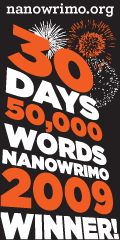
This is what I have been doing all November instead of reading books (though I did that too) and putting up my October reviews. And I made it! The fifth time's the charm, eh? And no, no one will be reading it besides me because it is complete crap. As a lover of great literature, I still find it difficult to create.
Monday, October 5, 2009
Project 50: September
I just have to get through one more book, then I've accomplished my goal for the year and can concentrate on National Novel Writing Month in November!
“The Short Bus: A Journey Beyond Normal” by Jonathan Mooney
The author, labeled “learning disabled” because of dyslexia had grown up being looked down upon, but graduated from Brown University with a degree in English literature. The book is not a story of “short bussers” overcoming the odds to become awesome. Mooney bought a little yellow bus and set out to see the experience of living with a disability label. I feel that his writing was really honest. Before meeting a young man with cerebral palsy, he gets really nervous because he’d thought he would only interview people with learning disabilities like himself, not conditions like cerebral palsy or Down’s Syndrome, but naming his own fears of encounters with people who are “different” gives a lot of depth to his project. A
“Without You: A Memoir of Love, Loss, and the musical Rent” by Anthony Rapp
I really like Rent, so when I stumbled on this while looking for books on bereavement, I nabbed it. Rapp focuses on three areas of his life: his mother’s illness and death, his sexuality and relationships, and anything involved with Rent, from the workshop where it began to the film version. It was emotional and touching. I didn’t find scenes from his sex life as a gay teenager to be too graphic. I laughed at the scene where he and a bunch of friends played Spin the Bottle and gave each other “ear sex.” The only thing that I didn’t like was that the only language he used to convey excitement was “shivers ran up my spine.” Over and over and over, especially when first hearing songs from Rent. I wish those scenes had had a little more varied language. B+
“Doctor Who: The City of the Dead” by Lloyd Rose
This book starts off like a good whodunit mystery but as questions are answered, it gets more confusing than before and crumbles into a bunch of disjointed scenes. Maybe it’s an 8th Doctor thing, but there was too much dark magic and other wacky stuff going on for my taste. At the end, I really didn’t have any clue what had happened in relation to the murder at the beginning. C
“The Curious Incident of the Dog in the Night-time” by Mark Haddon
I liked this book mostly because of the structure. The author writes from the perspective of an autistic 15-year old who wants to discover the murderer of his neighbor’s dog. The structure of the writing is such that every action or sense that he experiences gets processed and analyzed, right down to seeing a certain number of cars of a particular color in a day. The book jacket said that it was about a young man who can’t experience emotion, but I don’t think that whoever wrote that must have read the book, because he definitely reacts to his emotions. As the plot gets more intense for the main character, the sentences start to run together and you feel his panic translating to the inability to separate his thoughts. A
“The Memory Keeper’s Daughter” by Kim Edwards
This was a good story that went on for a bit too long and didn’t end the way that I thought it should have. It’s about a couple who have twins, and one is born with Down’s Syndrome. The husband is a doctor and delivers the babies in his office during a snowstorm, and the only other person there is a nurse. He gives the baby to the nurse and tells her to put her in an institution, but she ends up running away and raising the baby as her own. The husband tells the wife that the baby died and the secret creates an emotional rift between them for the next 20 years. I found the story, mm, a little too feminine, all about children and housewives and insensitive husbands, and clichéd in that the wife becomes an alcoholic housewife, bitter about her role in life. C+
Subscribe to:
Posts (Atom)
